October 11, 2015
Family Class Sponsorship - Conjugal Partner (Same-Sex Partner)
June 19, 2013
Happily Ever After: Ms. Carol and Ms. Denise's Story
![]() |
| The Lovely Couple, Ms. Carol and Ms. Denise, at Ottawa River |
Ms. Carol Manuel visited our office a couple of years ago to consult about her case. She is into a same-sex relationship with a Canadian citizen based in Quebec. Her partner, Ms. Denise, wanted to sponsor her under the family class sponsorship program and they have actually consulted several consultants and immigration lawyers prior to our meeting. They knew that it's not going to be easy. But after explaining the process, the fees and other stuff, they decided to get our services.
After getting the needed information about their relationship - as a matter of procedure and policy before accepting her case - I was convinced right there and then that this couple is so in love and that there is no doubt that their relationship is real - the emotional and financial inter-dependence is so obvious. They were so in-love and committed to each other, their distance is never a problem. They literally talk and see each other daily via webcam and they've been doing it for more than a year already!
Canada respects and recognize the rights of Lesbian, Gay, Bisexual, Transgender (LGBTs) and its immigration program also provides provision for these cases. But it isn't that easy to get approval for this kind of cases. You need to submit the right documents and information.
![]() |
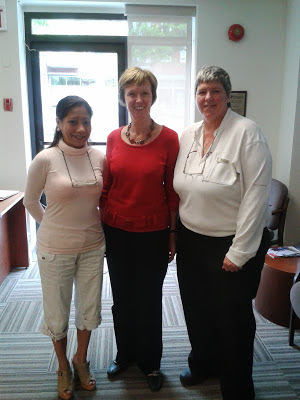
| Deputy Nycole Turmel (center) with the lovely couple |
Sometimes, you also need to be assertive - get help from the MPs if necessary. Otherwise, your application will simply be refused on the grounds that the visa officer is not convinced that the relationship is genuine. In their case, Deputy Nycole Turmel made sure that the Visa Office in Manila is properly handling their case, she went out of her way to contact the Visa Office and really talked to Ms. Carol and Ms. Denise. Or maybe that is the standrad to be expected from a public servant in Canada. But just the same, I can say Deputy Nycole Turmel is one great public servant.
It took more than a year before Ms. Carol received her visa. She was asked to explain details about the relationship during the personal interview. They questioned the limited period they lived together, among other things. The processing of Japan Police Certificate also added to the delay. Ms. Carol also have to repeat the medical examination becasue the first medical examination result already expired due to the delay in processng.
During the period of waiting, they were understanbly anxious of what the next requirement would be or the decision that the visa officer will make.
![]() |
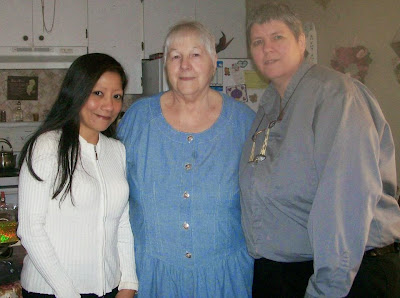
| Ms. Carol with Ms. Denise and her Mom |
![]() |
| Ms. Carol at home with her new family in Quebec |
July 24, 2008
Fiance Visa? | How to sponsor a spouse or a common-law or conjugal partner to Canada
What are the requirements for fiance visa? How to process sponsorship visa? I have a boyfriend in Canada, can he sponsor me so that I can work in Canada? If we will get married, can my spouse sponsor me?
But is there really a fiance visa program?
No. There is no fiance visa category in Canada's family class sponsorship. Information about application to sponsor spouse under Family Class Program is available for free at http://cic.gc.ca.
A Canadian citizen or a permanent resident of Canada can sponsor his spouse, common-law partner, conjugal partner, dependent child (including adopted child) or other eligible relative (such as a parent or grandparent) to become a permanent resident. There are two different processes for sponsoring your family. One process is used for sponsoring your spouse, conjugal or common-law partner and/or dependent children. Another process is used to sponsor other eligible relatives.
On this post, I'll write about sponsoring spouses or partners.
Sponsoring a spouse or a partner
(The following information were taken from Citizenship and Immigration Canada*)
You can sponsor a spouse, common-law or conjugal partner, or dependent children if you are a Canadian citizen or a permanent resident of Canada. To be a sponsor, you must be 18 years of age or older.
You can apply as a sponsor if your spouse, common-law or conjugal partner, or accompanying dependent children live with you in Canada, even if they do not have legal status in Canada. However, all the other requirements must be met.
You can also apply as a sponsor if your spouse, common-law or conjugal partner, or dependent children live outside Canada, and if they meet all the requirements.
When you sponsor a spouse, common-law or conjugal partner, or dependent children to become permanent residents of Canada, you must promise to support them financially. Therefore, you have to meet certain income requirements. If you have previously sponsored relatives to come to Canada and they have later turned to the government for financial assistance, you may not be allowed to sponsor another person. Sponsorship is a big commitment, so you must take this obligation seriously.
To be a sponsor:
You may not be eligible to be a sponsor if you:
You and the sponsored relative must sign a sponsorship agreement that commits you to provide financial support for your relative, if necessary. This agreement also says the person becoming a permanent resident will make every effort to support her or himself.
You must provide financial support for a spouse, common-law or conjugal partner for three years from the date they become a permanent resident.
You must provide financial support for a dependent child for 10 years, or until the child turns 25, whichever comes first.
Note:If you live in Quebec, you must also meet Quebec’s immigration sponsorship requirements, after Citizenship and Immigration Canada approves you as a sponsor.
failed to provide financial support you agreed to when you signed a sponsorship agreement to sponsor another relative in the past defaulted on a court-ordered support order, such as alimony or child support received government financial assistance for reasons other than a disability were convicted of a violent criminal offense, any offense against a relative or any sexual offense—depending on circumstances such as the nature of the offense, how long ago it occurred and whether a pardon was issued defaulted on an immigration loan—late or missed payments are in prison or have declared bankruptcy and have not been released from it yet.
Spouse
You are a spouse if you are married to your sponsor and your marriage is legally valid.
If you were married in Canada:
If you were married outside Canada:
You must have a marriage certificate issued by the province or territory where the marriage took place.
Sponsoring your same-s-e-x partner as a spouse
The marriage must be valid under the law of the country where it took place and under Canadian law. A marriage performed in an embassy or consulate must comply with the law of the country where it took place, not the country of nationality of the embassy or consulate.
You can apply to sponsor your same-s-e-x partner as a spouse if:
If you were married outside Canada, you may apply to sponsor your same-s ex partner as a spouse as long as the marriage is legally recognized according to both the law of the place where the marriage occurred and under Canadian law. This applies to same-se x marriages performed in the following jurisdictions:
you are a Canadian citizen and permanent resident and you were married in Canada and issued a marriage certificate by a Canadian province or territory on or after the following dates:
o British Columbia (on or after July 8, 2003) o Manitoba (on or after September 16, 2004) o New Brunswick (on or after July 4, 2005) o Newfoundland and Labrador (on or after December 21, 2004) o Nova Scotia (on or after September 24, 2004) o Ontario (on or after June 10, 2003) o Quebec (on or after March 19, 2004) o Saskatchewan (on or after November 5, 2004) o Yukon (on or after July 14, 2004) o all other provinces or territories (on or after July 20, 2005).
- Belgium
- the Netherlands
- South Africa
- Spain
- the State of Massachusetts.
You are a common-law partner—either of the opposite sex or same sex—if:
You will need proof that you and your common-law partner have combined your affairs and set up a household together. This can be in the form of:
you have been living together in a conjugal relationship for at least one year in a continuous 12-month period that was not interrupted. (You are allowed short absences for business travel or family reasons, however.)
- joint bank accounts or credit cards
- joint ownership of a home
- joint residential leases
- joint rental receipts
- joint utilities (electricity, gas, telephone)
- joint management of household expenses
- proof of joint purchases, especially for household items or
- mail addressed to either person or both people at the same address.
This category is for partners—either of the opposite s-e-x or same s-e-x —in exceptional circumstances beyond their control that prevent them from qualifying as common-law partners or spouses by living together.
A conjugal relationship is more than a physical relationship. It means you depend on each other, there is some permanence to the relationship and there is the same level of commitment as a marriage or a common-law relationship.
You may apply as a conjugal partner if:
- you have maintained a conjugal relationship with your sponsor for at least one year and you have been prevented from living together or marrying because of:
o an immigration barrier
o your marital status (for example, you are married to someone else and living in a country where divorce is not possible) or
o your sexual orientation (for example, you are in a same-s-e-x relationship and same-s-e-x marriage is not permitted where you live)
- you can provide evidence there was a reason you could not live together (for example, you were refused long-term stays in each other’s country).
- You could have lived together but chose not to. This shows that you did not have the level of commitment required for a conjugal relationship. (For example, one of you may not have wanted to give up a job or a course of study, or your relationship was not yet at the point where you were ready to live together.)
- You cannot provide evidence there was a reason that kept you from living together.
- You are engaged to be married. In this case, you should either apply as a spouse once the marriage has taken place or apply as a common-law partner if you have lived together continuously for at least 12 months.
You cannot be sponsored as a spouse, a common-law partner or a conjugal partner if:
you are under 16 years of age you (or your sponsor) were married to someone else at the time of your marriage
- you have lived apart from your sponsor for at least one year and either you (or your sponsor) are the common-law or conjugal partner of another person
- your sponsor immigrated to Canada and, at the time they applied for permanent residence, you were a family member who should have been examined to see if you met immigration requirements, but you were not examined or
- your sponsor previously sponsored another spouse, common-law partner or conjugal partner, and three years have not passed since that person became a permanent resident.
To convince the Visa Office that your marriage was not entered into primarily for the purpose of acquiring status or privilege under the Immigration and Refugee Protection Act, here three important things to consider -
Again, there is no Fiance Visa category in the Immigration and Refugee Protection Act of Canada. It's either you get married or submit proof that you are common-law or conjugal partners. Remember though, that getting married, even if legal, does not guarantee a visa!
Submit the correct forms and provide all the required information. Do not leave any field blank. If it's not applicable, put N/A on it. Be consistent with the information you will provide
Demonstrate strong communication or commitment to the marital relationship and that you are mutually interdependent
Provide verifiable documents to corroborate information that will be provided
If you think you need help, take our FREE Online Assessment now.
Popular Posts
-
Many work permit and PGWP holders assume that courses under six months don’t require a study permit — but immigration law isn’t always that ...
-
Just got PR through OINP Employer Job Offer? Find out if you can change jobs, what immigration law allows, your rights as a permanent reside...
-
If you’re in Canada on a work permit or transitioning to a Post-Graduation Work Permit, your legal status determines whether you can continu...
-
You started with an LMIA-based work permit under TEER 4. Now your employer moved you to a TEER 3 position. The big question: does this count...
-
A single criminal conviction — even for a hybrid offense prosecuted summarily — can trigger inadmissibility under section 36 of the Immigrat...
About Gateway to Canada
Gateway to Canada is a consortium of immigration service providers specializing in delivering a comprehensive range of services tailored to address the diverse needs of individuals seeking visa applications for Canada. Our array of services encompasses assistance with visa applications, support for school admissions, landing services, financial planning, provision of insurance, and investment guidance.
With an outstanding team of seasoned professionals, Gateway to Canada ensures unwavering support and guidance for our esteemed clients throughout the immigration process and their settlement in Canada. Our mission is to empower individuals with the utmost efficiency and help them achieve their desired goals by providing an unparalleled journey to Canada.
Canadian Immigration Consultancy:
Making Canadian Dream Happen
Since 1989
As career and life planner, Canadian Immigration Consultancy has guided more than 70,000 Filipinos in securing immigrant visas for Canada. We have set up graduates on a professional career path, reunited families, placed students on the education pathway to immigration, and demonstrated the benefits of immigration over an OFW life.
Time and again we have shown how immigration can help Filipinos work towards a more permanent solution to their financial challenges. We strongly advise against taking the quick but ultimately temporary fix of becoming an OFW.
Immigration though takes commitment. It also takes a consultant who is up to date on immigration regulations, quick to grasp opportunities when they open up for our clients and meticulous in guiding them through a maze of rules, processes and forms.
By working together and by developing stronger relationships with our partners and clients, we are helping each and every applicant achieve real financial security. We are helping families help themselves.
We make your dreams of financial security come true.
We are CIC. We are your Gateway to Canada.


